
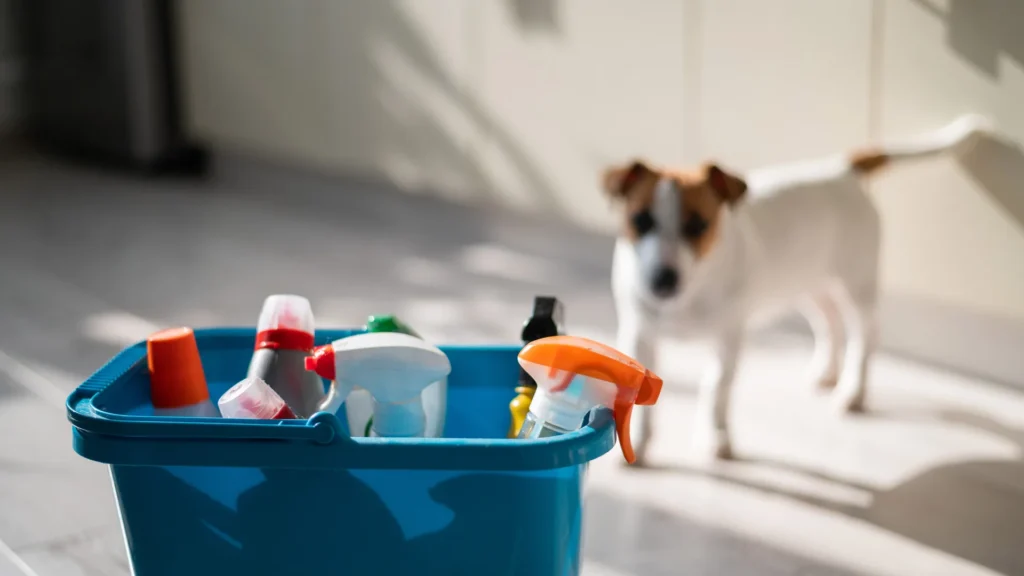
Most pet owners know that some cleaning products are dangerous if a pet ingests them directly. Fewer are aware that the risk extends well beyond that. Residue on floors that dogs walk across and lick from their paws, fumes in enclosed spaces, and compounds absorbed through skin contact with recently cleaned surfaces all represent real exposure pathways.
Pet safe cleaning products are not a niche preference. For households with dogs, cats, or birds, they are the practical baseline for a home where the cleaning routine is not quietly working against the animals in it.
How pets are exposed to cleaning products
The exposure pathways for pets are different from those for adults and in several ways more significant.
Floor contact. Dogs and cats spend time on floors in ways adults do not. They lie on them, press their noses to them, and in many cases sleep directly on them for hours. Cleaning product residue remains on floor surfaces after the floor appears dry. Pets are in contact with that residue continuously.
Paw grooming. Dogs and cats both groom their feet. Residue picked up from floors during movement is ingested during grooming. This happens throughout the day, so a pet living in a home with residue-leaving cleaning products on floors is being exposed repeatedly and incrementally.
Airborne exposure. Volatile cleaning compounds evaporate into the air during and after application. Pets breathe at a lower level than standing adults, where some vapors concentrate. Cats and birds are particularly sensitive to airborne chemical exposure due to differences in respiratory biology.
Species-specific metabolic limitations. Cats lack certain liver enzymes that metabolize compounds common in cleaning products, particularly phenols and some essential oils. Compounds that a human body processes without consequence can accumulate to toxic levels in a cat. Dogs are more metabolically robust but are not without vulnerabilities.
Cleaning compounds to avoid in homes with pets
Phenols and phenolic disinfectants
Phenols are found in many commercial disinfectants and are the compound that gives pine-scented cleaners their characteristic smell. They are highly problematic for cats. Feline livers cannot break down phenolic compounds, and exposure through floor contact or inhalation can cause liver damage over time.
Products to check: many disinfectant sprays contain phenols or phenolic derivatives. Check the active ingredient list, not just the warning label.
Benzalkonium chloride
Benzalkonium chloride (BAC) is a quaternary ammonium compound used in many surface disinfectants and wipes. The ASPCA Animal Poison Control Center lists it as a cause of significant poisoning incidents in companion animals annually. It causes respiratory irritation, oral burns, and gastrointestinal distress in cats and dogs at concentrations found in standard household products.
Bleach and chlorine compounds
Bleach fumes cause respiratory irritation in pets, particularly in cats and birds. Even diluted solutions leave residue that can cause chemical burns on paws or gastrointestinal irritation if ingested through grooming. The critical issue is not careful use in good ventilation: it is that fumes persist in enclosed spaces after cleaning is complete and pets are confined to those spaces.
Ammonia
Found in many glass cleaners and multi-purpose sprays. Ammonia is a respiratory irritant for both humans and animals. The smell is acutely distressing to dogs, whose olfactory sensitivity is many orders of magnitude more acute than a human’s. Regular exposure in the home is associated with respiratory symptoms in pets.
Essential oils
This category surprises many pet owners because essential oils have a natural origin and are frequently marketed as safer alternatives. For cats, many essential oils are genuinely toxic: tea tree oil, citrus oils, eucalyptus, peppermint, and pine oil are among those the ASPCA identifies as potentially harmful. Dogs are less sensitive but not risk-free at higher concentrations.
Diffusing essential oils creates continuous airborne exposure for pets. Using essential oil-based cleaning products on floors creates residue contact. Natural origin does not determine safety for animals.
Phthalates
Used as fragrance fixatives in cleaning products. Phthalates are endocrine disruptors associated with reproductive and developmental effects in animal studies. Because they are part of fragrance formulations, they often do not appear on ingredient lists. Products listing only “fragrance” as a component may contain phthalates.
What to look for in pet safe cleaning products
EPA Safer Choice certification. The EPA Safer Choice program evaluates cleaning products against safety criteria for human health, aquatic life, and air quality. Products carrying the Safer Choice label have been assessed for ingredient safety and are appropriate for use in homes with pets.
Enzyme-based cleaners. Enzyme cleaners use biological compounds that break down organic material. They are the most effective option for cleaning up pet accidents because they digest the organic compounds causing odors rather than masking them. They are also safe for pets once dry.
Plant-derived surfactants. Surfactants from coconut oil, corn, or other botanical sources are effective cleaning agents without the toxicity profiles of petrochemical-derived alternatives.
Castile soap. A vegetable-oil-based soap effective for general cleaning at appropriate dilutions. Safe for pets. Not appropriate on waxed surfaces, natural stone, or in hard water without rinsing.
Baking soda. Non-toxic, mildly abrasive, effective for scrubbing tile, grout, and other surfaces. Safe for pets.
What “natural” and “green” labels mean: very little without third-party certification. These terms are not regulated. A product can label itself natural and still contain phenols or essential oils at unsafe concentrations. Reading the ingredient list and cross-referencing with the ASPCA Animal Poison Control list is more reliable than trusting marketing language.
Room-by-room application
Kitchen floors
Dogs spend significant time near food preparation areas. Use a floor cleaner with EPA Safer Choice certification or a diluted castile soap solution. Allow the floor to dry completely before pets return. For routine cleaning between deeper cleans, a microfiber mop with hot water alone is effective on tile without leaving chemical residue.
Bathroom
The bathroom has the highest concentration of potentially problematic products. Keep all cleaning products in secured cabinets, not accessible to pets. Never leave cleaning solution in a bucket on the floor.
After cleaning bathroom surfaces, rinse thoroughly before the room is accessible to pets. This is particularly important for toilet bowl cleaners, which leave chemical residue in the bowl that pets may drink from if given access.
Laundry area
Laundry pods are attractive to dogs due to appearance and scent, and are highly concentrated. Store all laundry products in closed cabinets above pet reach. For pet bedding and soft toys laundered regularly, fragrance-free and dye-free formulations reduce chemical exposure.
Floors throughout the home
The floor is the highest-exposure surface for any pet. Whatever product cleans the floor is what pets are in contact with for hours every day. Floor cleaning product is the highest-priority category to switch if you have not already reviewed it.
Outdoor areas and decks
Pets spend time on deck and patio surfaces cleaned with exterior products. The same principles apply: products with phenols, benzalkonium chloride, or high concentrations of essential oils are not appropriate for surfaces where pets have direct skin contact. Allow all treated outdoor surfaces to dry and air thoroughly before pets have access.
Signs your pet may have been exposed to a cleaning product
Symptoms of chemical exposure in dogs and cats include: excessive drooling or salivation, vomiting, difficulty breathing, coordination problems, lethargy, redness or burns around the mouth or paws.
If you suspect exposure, contact the ASPCA Animal Poison Control Center at (888) 426-4435. There is a consultation fee, but the service provides guidance from veterinary toxicologists specific to the product and exposure. Do not attempt to induce vomiting unless directed by a professional, as this causes additional damage with some chemical exposures.
Common mistakes pet owners make with cleaning products
- Assuming “natural” or “plant-based” means safe for all animals
- Using disinfectant wipes on surfaces pets will contact within an hour
- Running an essential oil diffuser in spaces where cats are confined
- Not rinsing bathroom surfaces after cleaning before pets have access
- Storing cleaning products in under-sink cabinets accessible to dogs
FAQ: pet safe cleaning products
Is white vinegar safe for cleaning in homes with pets? White vinegar is non-toxic to dogs and cats at typical cleaning dilutions. It should not be used on natural stone, hardwood with polyurethane finish, or porous grout, as the acidity degrades these surfaces. On appropriate surfaces, diluted white vinegar is a safe and effective cleaning agent.
Are disinfectant wipes safe around pets? Most disinfectant wipes contain quaternary ammonium compounds including benzalkonium chloride, or bleach derivatives. Neither is safe for surfaces pets will contact shortly after use. If you use them, allow the surface to fully dry and then wipe with a damp cloth before pet contact.
What is the safest way to clean up a pet accident? An enzyme cleaner specifically formulated for pet accidents. Enzyme cleaners break down the organic compounds in urine and feces rather than masking them, which eliminates both the source of the odor and the stain. Safe on most flooring types and for pets once dry.
Is steam cleaning safe around pets? Steam cleaning uses heat and water vapor without chemical products, making it one of the safest options for floors in homes with pets. High temperature effectively sanitizes surfaces. The limitation is that steam can damage certain finishes, including hardwood, and should not be used on those surfaces.
How long should I keep pets out of a room after cleaning? The minimum is the drying time, when residue is most concentrated on surfaces. For products with significant concerns, such as phenolic disinfectants or bleach, a longer waiting period plus active ventilation is appropriate. EPA Safer Choice certified products and enzyme cleaners have shorter re-entry windows.
Safe cleaning is achievable without sacrificing effectiveness
The choice between cleaning products that work and cleaning products that are safe for pets is not a real trade-off. Effective, safe alternatives exist for every cleaning task. The transition requires attention to ingredient lists rather than brand names, and a willingness to move away from familiar products that happen to contain problematic compounds.
Your pets are on those floors every day. Request a quote for residential cleaning with pet safe, eco-friendly products in Nantucket, Martha’s Vineyard, or Cape Cod and stop guessing about what is on the surfaces they sleep, walk, and groom on.
