
Working from home means you control the environment, which also means you are responsible for whether it helps or hurts your focus. A cluttered, disorganized workspace drains energy and increases distractions. A well-organized home office, by contrast, sets you up to do your best work every day.
This guide covers nine practical home office organization ideas that improve your setup, reduce clutter, and help you stay focused throughout the workday. Whether you have a dedicated office room or a desk in the corner of a bedroom, these strategies make a real difference.
How home office organization affects productivity
Physical clutter in your work environment competes for your visual attention. It signals to your brain that there are unfinished tasks everywhere, making it harder to focus on the one task in front of you.
A disorganized workspace also slows you down in practical ways. You spend time searching for documents, cables, and supplies that should be immediately accessible. You lose focus between tasks because the environment itself is chaotic.
Home office organization solves these problems by creating a system where everything has a place and distractions are minimized. The investment in setting up your workspace properly pays dividends in concentration and efficiency every single day.
9 home office organization ideas
1. Start with a full desk declutter
Before adding any new organization systems, clear your desk completely. Take everything off the surface, out of drawers, and down from shelves. Then evaluate each item honestly.
Items that belong on your desk should meet one simple test: do you use this every day? If not, it belongs in a drawer, a cabinet, or somewhere else entirely.
Most home office desks accumulate items that have no real business being there: old receipts, expired pens, chargers for devices you no longer own, and notes that served their purpose months ago. Remove them before organizing anything else.
2. Create zones within your workspace
Even a small home office benefits from intentional zones. This approach, which professional organizers apply to kitchens and living spaces, works equally well in a workspace.
Basic workspace zones:
- Active work zone: Your desk surface and immediate reach area, containing only what you use daily
- Reference zone: Bookshelves, filing cabinets, or drawers holding documents and resources you access regularly
- Supply zone: A designated drawer or organizer for pens, paper, sticky notes, and office supplies
- Technology zone: A managed area for charging cables, peripherals, and devices
When each category of item has a dedicated zone, the workspace stays organized naturally because everything has a logical place to return to.
3. Manage cables and cords
Few things make a home office look messier than tangled cables. Loose cords across the desk and trailing down to the floor create visual chaos and get in the way of practical work.
Simple cable management solutions:
- Cable clips or adhesive cable holders to route cords along the underside of the desk
- A cable management box to hide power strips and excess cord length
- Labels on each cable so you know what each one connects
- Velcro ties to bundle cords that run together
This small investment creates an immediate improvement in how clean and professional your workspace feels.
4. Use vertical storage to free up desk space
Desk space is valuable. Moving storage off the surface and onto the wall creates more room to work without reducing what you have access to.
Vertical storage options for a home office:
- Floating shelves above the desk for books, plants, and reference materials
- A wall-mounted pegboard for hanging supplies, headphones, and accessories
- A bulletin board or whiteboard for notes, reminders, and project tracking
- A monitor arm that lifts the screen off the desk and creates space underneath
Even in a small home office, a few well-placed shelves can transform the amount of usable workspace.
5. Set up an effective filing system
Paper clutter is one of the most common home office organization challenges. Without a clear system for incoming and outgoing documents, paper accumulates on every surface.
A simple, effective filing system includes:
- An inbox tray for documents needing action
- A filing cabinet or accordion folder for documents to keep long term
- A shredder for documents to discard securely
- A consistent habit of processing the inbox tray at least once per week
For most home office users, a simple A-Z or category-based filing system works well. The key is consistency. Every piece of paper gets processed and filed rather than left on the desk to pile up.
Transitioning to digital filing for documents that do not require physical storage also reduces paper clutter significantly.
6. Invest in a quality chair and ergonomic setup
Home office organization includes your physical environment, not just storage and visual tidiness. Poor ergonomics leads to discomfort, distraction, and fatigue that directly affect how productive you are.
Key ergonomic elements for a well-organized home office:
- Chair height adjusted so your feet rest flat on the floor
- Monitor at eye level to prevent neck strain
- Keyboard and mouse positioned to keep wrists neutral
- Adequate lighting to reduce eye strain
For ergonomics guidance, the Occupational Safety and Health Administration provides practical recommendations on setting up a safe and comfortable home workstation.
7. Control visual distractions
Visual clutter is not the only distraction in a home office. Too much visual interest, from family photos to art to window views, can also pull your attention during focused work periods.
This does not mean your office needs to be bare. It means being intentional about what you include. One or two meaningful objects are enough to personalize the space without competing for attention.
Positioning your desk so the primary view is toward a blank wall or neutral surface rather than a window or open doorway reduces the amount of visual information competing for your attention while you work.
8. Create an end-of-day reset routine
The most organized home office stays organized because of daily habits, not just the initial setup. A five-minute end-of-day reset makes a meaningful difference in how your workspace feels the next morning.
At the end of each workday:
- Clear the desk surface of any items that accumulated during the day
- File or discard any new paper
- Return office supplies to their designated zone
- Close or put away any open notebooks or printed documents
- Prepare your desk for the following day’s tasks
Starting each morning with a clear desk reduces the friction of beginning work and sets a productive tone for the day ahead.
9. Maintain with a weekly deep clean
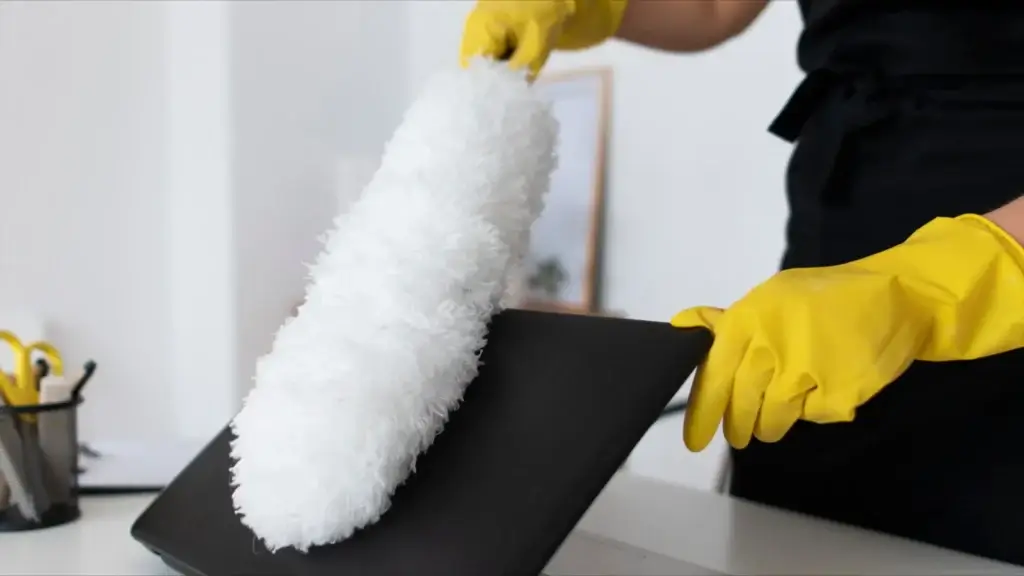
Home office organization also includes keeping the space physically clean. A dusty monitor, sticky keyboard, and grimy desk surface affect the work environment in subtle but real ways.
Schedule a brief weekly cleaning of your home office:
- Wipe down the desk, monitor, and keyboard with appropriate cleaning cloths
- Dust shelves and surfaces
- Vacuum or mop the floor
- Wipe door handles and light switches
Quality Clean Service includes home offices in their residential cleaning services for homes across Nantucket, Cape Cod, and Martha’s Vineyard.
Daily habits for sustaining home office organization
Remote work is most effective when organization is built into your daily rhythm rather than treated as a periodic project.
Three habits that high-performing remote workers maintain:
Morning setup ritual: Before starting work, spend two minutes confirming your workspace is clear and ready. Move anything that does not belong and open your tools before beginning.
Paper processing cadence: Process incoming mail, printed documents, and notes daily or at minimum twice a week. File, act on, or discard each piece before it becomes part of the landscape.
Weekly Friday reset: Before ending the workweek, spend ten minutes returning everything to its proper place. Clear the desk completely. This creates a clean start on Monday and prevents the weekend from blurring into the workweek visually.
These habits, combined with the nine ideas in this guide, create a home office that consistently supports focused, productive work.
When to call a professional organizer
If your home office has reached a point where the disorder feels overwhelming, or if you have tried to organize it multiple times without lasting results, a professional organizer brings fresh perspective and practical expertise.
Quality Clean Service offers professional organizing services that extend to home offices as well as kitchens, closets, and garages. For a room-by-room approach to getting the entire home organized, their decluttering service covers every space with the same practical methodology.
Your best work starts with the right environment
Home office organization is one of the most impactful improvements you can make to your work-from-home experience. Start with one or two ideas today, clear the desk, manage the cables, or set up a simple filing system. Small improvements compound quickly.
The connection between organization and work-from-home success
Remote work has made the home office one of the most important rooms in any household. Yet it is also one of the most commonly neglected when it comes to intentional design and organization.
The difference between a home office that supports your best work and one that undermines it often comes down to a few consistent habits and a well-considered setup.
Three habits that high-performing remote workers build into their daily routine:
Morning setup ritual. Before starting work, spend two minutes confirming your workspace is clear. Move anything that does not belong and open your tools for the day.
Paper processing cadence. Incoming mail, printed documents, and notes accumulate quickly. Process them daily or at minimum twice a week. File, act on, or discard each piece before it becomes part of the landscape.
Weekly Friday reset. Before ending the workweek, spend ten minutes returning everything to its proper place. This creates a clean start on Monday and prevents the weekend from blurring into the workweek visually.
These habits, combined with the nine organization ideas in this guide, create a home office that consistently supports focused, productive work.
