
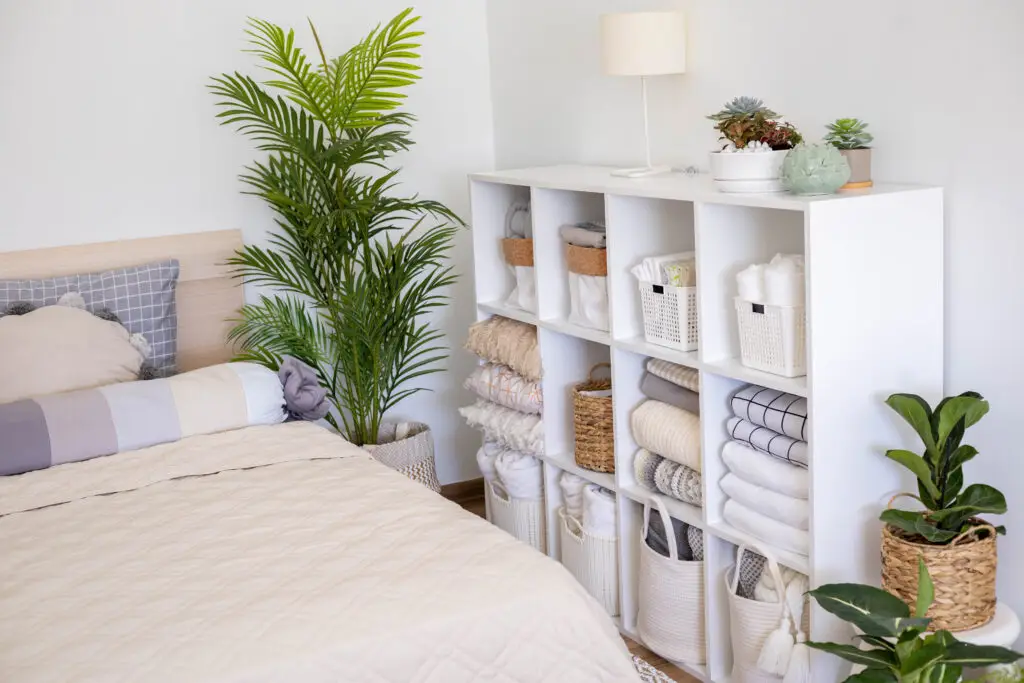
A disorganized bedroom does more than look messy. It actively works against you. Clutter on the nightstand, clothes on the chair, and items without a home all signal to your brain that there is unfinished work to do, even when you are trying to rest.
Learning how to organize a bedroom properly creates a space that supports sleep, reduces daily friction, and is genuinely easier to maintain. This guide walks through every step, from the initial declutter to the habits that keep the room working long-term.
Quick answer
How do you organize a bedroom?
- Remove everything from surfaces, drawers, and the closet.
- Declutter: keep only what belongs in the bedroom and what you actually use.
- Group items by category before putting anything back.
- Assign a designated place for every item.
- Use the right storage: under-bed bins, closet organizers, nightstand drawers.
- Keep surfaces clear as a daily habit.
- Do a five-minute reset each evening to maintain the system.
Why bedroom organization matters more than other rooms
The bedroom is the one room in the home dedicated to rest and recovery. Its condition directly affects sleep quality, and sleep quality affects everything else.
The National Heart, Lung, and Blood Institute at NIH recommends keeping the bedroom quiet, cool, and dark as part of healthy sleep habits. A cluttered, visually busy environment works against all three of those conditions. Research published in the journal Sleep found that regular bedroom decluttering was associated with improved sleep quality and fewer nighttime disturbances.
Professional organizers who work in bedrooms regularly see the same patterns: clothes on a chair that has not been used for sitting in months, nightstands covered in three layers of items, and closets so full that getting dressed becomes a daily source of stress. The bedroom ends up functioning as a catch-all for items that do not have a home elsewhere in the house, and that drift accumulates quickly.
Organizing the bedroom is not just about tidiness. It is about reclaiming the room’s actual purpose.
Step 1: Empty the room before you organize a bedroom
The most effective way to organize a bedroom is to start from a blank slate. Pull everything out of the closet, every drawer, and every surface. Place it all on the bed or the floor.
This step feels disruptive, but it is necessary. You cannot make good decisions about what to keep and where to put it if items are still in their original places. Seeing everything at once also reveals duplicates, items that drifted in from other rooms, and things you forgot you owned.
If emptying the entire room at once feels too overwhelming, work one zone at a time: the closet first, then the dresser, then the nightstand, then any other storage surfaces. Complete each zone fully before moving to the next.
Step 2: Declutter with firm criteria
With everything out, sort each item into three groups: keep, donate, or discard. Do not create a “maybe” pile. Items without a clear place always end up back in the room unchanged.
Ask these questions for each item:
- Do I use this at least once a month?
- Does it belong in the bedroom, or has it drifted here from somewhere else?
- Do I have a duplicate I like better?
- Does this item support rest and sleep, or does it add visual noise?
Be especially honest about:
- Clothes that have not been worn in over a year
- Books, magazines, and paperwork that accumulated on surfaces
- Chargers and cables for devices that no longer exist
- Decorative items that were placed but never really chosen
- Items stored in the bedroom because there is no better place for them elsewhere
That last category is common. When the bedroom becomes the overflow room for the rest of the house, the only fix is addressing storage in those other areas too. A temporary solution is to box those items and move them out of the bedroom while you find them proper homes.
Step 3: Organize the bedroom closet
The closet is often where bedroom organization fails or succeeds. A well-organized closet makes getting dressed fast and easy. A disorganized one creates a ripple of mess into the rest of the room.
Sort clothes by category and frequency of use
Group clothes by type: tops together, bottoms together, dresses, jackets, and so on. Within each group, put the items you wear most often at eye level and within easy reach. Items used occasionally go higher or lower.
Rotate seasonally
Store off-season clothing in vacuum-seal bags, labeled bins, or a separate drawer. Winter coats and heavy sweaters in summer, light layers and warm-weather clothing in winter. This frees up a significant amount of closet space and makes the current season’s wardrobe immediately accessible.
Use the full height of the closet
Most closets have unused space above the hanging rod and on the floor below. Add a second hanging rod for shorter items like shirts and jackets. Use the upper shelf for bins with labels. Use floor space for a shoe rack or a low drawer unit.
Add dividers, bins, and hooks
Drawer dividers keep folded items like socks and underwear from collapsing into a mixed pile. Small baskets or bins on shelves group accessories, scarves, or small items. A hook on the inside of the closet door holds bags, belts, or tomorrow’s outfit.
Step 4: Set up bedroom storage that works
Every item in the bedroom needs a designated home. If something does not have a place, it will end up on a surface. The goal is to assign storage before clutter has a chance to form.
Under-bed storage
The area under the bed is one of the most underused spaces in a bedroom. Low rolling drawers or flat storage bins work well for:
- Off-season clothing
- Extra bedding and pillows
- Shoes that are used but not daily
- Items that need to be accessible but not visible
Use clear bins or label everything. Under-bed storage works only if you can find what you put there.
Nightstand with drawers
A nightstand with at least one drawer keeps the bedside surface clear. The surface itself should hold only what you use every night: a lamp, one book, a glass of water. Everything else belongs in the drawer: phone charger, hand lotion, lip balm, any medication taken at night.
If the nightstand has only a surface, add a small tray or box. Even a defined container limits what accumulates there.
Dresser organization
Each dresser drawer should hold one category of item. One drawer for socks and underwear, one for folded tops, one for loungewear. Vertical folding, sometimes called file folding, makes every item visible from the front rather than buried in a pile. This single change makes it easier to find items and easier to put them away.
Additional storage options
- A storage ottoman at the foot of the bed holds blankets, pillows, or seasonal items
- Floating shelves above the dresser or on empty walls add display and storage space without floor footprint
- Hooks on the back of the door hold robes, towels, or bags
- A small tray or valet stand for the items that typically end up on the dresser top: watch, jewelry, keys, wallet
Step 5: Organize the bedroom surfaces
Once storage is in place, address every surface in the room. The goal is not to make surfaces completely bare. It is to make sure every object on them is there by choice, not by default.
Dresser top: Clear everything off. Wipe it down. Put back only what you want to see: a mirror, a small tray for daily essentials, one or two decorative items. Everything else goes into a drawer or leaves the room.
Nightstand: The same principle applies. Surface items are limited to what you use every night. Anything else goes in the drawer.
Floor surfaces: Clothes on the floor are almost always a symptom of a closet that is too full or too disorganized to make putting clothes away feel easy. Fix the closet first and the floor problem usually resolves itself. A small hamper in an accessible spot helps with items that are worn but not ready to wash.
Windowsills and other flat surfaces: These tend to collect small items over time. Clear them completely and only return items that genuinely belong there.
Step 6: Create a bedroom environment that supports sleep
Organization is not only about storage. It is also about creating the conditions for the room to do its job.
The NIH recommends keeping the bedroom quiet, dark, and cool. Once the clutter is cleared, a few additional steps make a meaningful difference:
- Keep electronics off surfaces where possible. Phones on the nightstand increase the temptation to scroll before sleep. Charge them across the room or in another room entirely.
- Use blackout curtains or room-darkening shades if outside light is an issue.
- Keep the temperature between 60 and 67 degrees Fahrenheit if possible. This range is consistently associated with better sleep quality.
- Limit what comes into the bedroom. Work materials, exercise equipment, and items that belong in other rooms all add to the mental load of the space.
Common mistakes when organizing a bedroom
These are the errors that most commonly undermine bedroom organization:
- Buying storage before decluttering: Storage products only work if the items in them are worth keeping. Buying bins first locks in the clutter.
- Organizing by room rather than by use: Items that belong in other rooms do not become bedroom items just because they are stored there.
- Full closets with no breathing room: A closet packed to capacity is impossible to maintain. Leave space in each section for easy access and returns.
- Nightstands as storage surfaces: Nightstands attract clutter faster than any other surface in the bedroom. Clear them daily.
- No defined place for frequently used items: If the watch, phone, and keys do not have a consistent home, they end up wherever there is space, which is usually a surface.
- Skipping the maintenance habit: Even a well-organized bedroom returns to clutter without a brief daily reset.
Signs your bedroom organization system needs a reset
Watch for these signals that the current setup is not working:
- You avoid the closet and wear the same few items because everything else is buried
- Surfaces refill with clutter within a day or two of being cleared
- Getting ready in the morning takes longer than it should
- You regularly cannot find specific items: a particular shirt, a charger, a shoe
- The room feels visually busy even when it is technically clean
- You feel more alert and stressed in the bedroom than calm
Any of these signals point to a storage or systems problem, not a discipline problem. The fix is usually a closet adjustment, a storage addition, or a declutter session, not trying harder.
How often to organize a bedroom
| Task | Frequency |
|---|---|
| Daily surface reset (nightstand, dresser top) | Every evening |
| Put away clothes and items out of place | Daily |
| Closet and drawer tidy | Monthly |
| Full declutter review | Every 3 to 6 months |
| Seasonal clothing rotation | Twice a year |
Pairing the seasonal clothing rotation with a broader home clean is efficient. If that kind of full-home reset is useful to you, our residential cleaning service can handle the deep clean while you focus on the organization side.
Frequently asked questions
Where do you start when organizing a bedroom? Start by emptying one area completely, either the closet or the nightstand. Remove everything, declutter, then return only what belongs there. Completing one area fully before moving to the next builds momentum and prevents the feeling of making things worse before they get better.
How do you keep a bedroom organized long term? Two habits: a five-minute evening reset where everything returns to its designated place, and a quarterly declutter to remove items that no longer belong. When every item has a clear home, maintenance requires almost no effort.
What should not be stored in a bedroom? Work materials, exercise equipment, excess furniture, items from other rooms that lack a proper storage space, and anything that adds visual noise without serving a sleep-related function. The bedroom works best when its purpose is clear: rest and the routines directly connected to it.
How do you organize a bedroom with a small closet? Maximize vertical space with a second hanging rod for shorter items, shelf dividers, and over-door hooks. Use under-bed storage for off-season clothing. Rotate seasonally. Donate or store anything that does not fit in the current season’s wardrobe. A small closet that holds only what you currently wear is more functional than a large one that holds everything.
How do you get rid of bedroom clutter for good? Assign a designated storage home for every item that belongs in the bedroom. Items that appear on surfaces without a home either need a storage solution or need to leave the room. The key question for every object: does this belong here, and does it have a clear place?
Is it worth hiring a professional organizer for a bedroom? Yes, particularly when previous attempts have not held, after a move, after a significant life change, or when the disorganization feels overwhelming. A professional organizer provides both the system design and the accountability to see it through. Our professional organizing service works with homeowners across Nantucket, Cape Cod, and Martha’s Vineyard.
How long does it take to organize a bedroom? For a standard bedroom, a full organization session, including decluttering, closet work, and setting up storage, typically takes four to six hours. Doing it in two or three focused sessions over a week is equally effective and less physically and mentally demanding.
A bedroom that actually supports rest
Knowing how to organize a bedroom is knowing how to protect your sleep and your mornings. The steps are straightforward: clear out what does not belong, assign a home for what does, and build the two habits that keep it working.
The room does not need to be minimal or magazine-worthy. It needs to be functional, calm, and easy to maintain. When those conditions are in place, the bedroom becomes what it is supposed to be: a space for genuine rest.
If a full bedroom organization project feels like too much to take on alone, our professional organizing team can walk through it with you and set up a system built around how you actually live.
